Hi folks!
You might have found this blog because you've read a write-up about the Brosie the Riveter joke that my buddy Sam Kirk and I played at our company, the write-up of which was originally hosted on The Hawkeye Initiative. To our surprise and pleasure, it went viral. :) It wound up on sites like Kotaku, PC Gamer, and Wired. There's an interview with me up on Wired, too, here.
This is a blog I've used from time to time in the past. It has been mostly for data science rants, sometimes for silly things. The Hawkeye Initiative blog post was my first posting about gender issues. You can follow me on twitter, where I also post rarely, here: @K2_said. If you want to contact Sam or myself, you can do so through Twitter, through Sam Kirk's site, or through the Hawkeye Initiative.
I might blog/tweet more now! But man it takes up hella time.*, ** So we shall see.
--K2
* Including troubleshooting why some of the older formatting on this blog is hosed.
** Oh, you heard me right. I said: "hella."
Thursday, May 16, 2013


Artist/collaborator Sam Kirk on (ahem) Brosie the Riveter :)
Possibly
the most positive thing about this Brosie experiment – right up there with Mark
Long’s amazing response, and the internet’s equally positive response – has been
working with Sam Kirk. For the first few months after I had the idea, I didn’t
think I’d find an artist with the talent and the sense of humor to make it work.
But when I asked around, there he was, right in my own company! And Sam’s
involvement fundamentally changed the idea for the better. Beyond his raw
talent, Sam had this marvelous instinct for making the satire warm and friendly.
It was Sam who suggested the Meteor Entertainment cultural in-jokes that are
hidden in the picture. (For example, Brosie’s face is from one of our beloved
co-workers.) And better yet, Sam is fucking hilarious. For about a month
(late nights and weekends for Sam, which he did totally pro bono), we passed
proofs back and forth, drunk on funny.
Sam
and I share a lot of values, not only on gender politics (which is remarkable enough),
but also on the importance of collaboration. As such, I’d like to hand Sam the microphone
for a bit to respond to some of the same questions that WIRED asked me. Take it
away, Sam:
I'd love to hear your
thoughts about the reaction to the piece so far. Why do you think it's gotten
such a positive and viral response?
SK: I’m shocked by the scope and velocity of the reaction, but I’m
not surprised by the tone. We’ve seen this topic bring out the worst in people,
especially in venues that house cowardice the way comment streams can. Discussions
break down quickly when people’s sensitivities are threatened. But in this case,
we introduced a typically charged subject in an absurdly disarming way. When
the discussion must pause for the chuckles, it’s a lot easier to take the
parallelism of the two posters at face value and question how someone could be
so caught off guard by one, and not by the nearly identical one.
Have you experienced
any backlash because of the story (or the prank) online or in real life?
SK: Meteor is full of reasonable people; I’ve not experienced any
backlash. Online you can see the occasional pseudonymous flame, but most of the
exchange has been encouraging. Even stalwart opposition to the prank has been
spoken with some stint of tact.
What I’m curious about is the conversation that isn’t documented. Throughout
most of the online comments, preconceptions persist and there’s a dearth of flipped
bits. But we don’t know what unfolds once readers turn from their screens and
interact with people in person. We’ll
have to punk Mark again next year and compare the chatter to measure the change.
What would you say to
other video game companies that want to do better with their approach to
gender, both in terms of their games and their female employees/office
environment?
SK: I think it comes down to individuals as much as the
company. In working with K2 I was
reminded that it’s worth speaking up in the face of some heinous imbalance,
even I don’t feel personally affected by it. It’s embarrassingly rudimentary in
hindsight, but this process has been a welcome nudge. Coercion often comes in a
trickle, not a downpour. By remaining active consumers of our environment and
influences we can take a whole lot more from them, and dish a whole lot more
back.
One thing Meteor does exceedingly well is foster a lively
environment for healthy discourse. From top to bottom, idiosyncrasies are
appreciated, if not nurtured. For the
most part, people don’t take themselves too seriously. I think that’s really
important. We only accomplish anything together, so it pays to let your guard
down and listen.
That said, I think my best advice would be to hire outspoken women.
[K2] Sam and guys like him have changed my perspective on feminism. May they always join us behind the podium.
[K2] Sam and guys like him have changed my perspective on feminism. May they always join us behind the podium.
Monday, April 16, 2012
Oliver’s Twist: Has the SPD pawn shop sting reduced property crime?
Note: I wrote this a year ago, when I decided to commit to a career in data science. I did it to refresh some skills, and to give potential employers a sense of how I approach problems. It worked really well. If you are a data science newbie, I recommend doing stuff like this. -- K2 -- 2013-04-01
Here’s an example of how easy it can be to explore a data set when you combine powerful, user-friendly tools like Socrata (which publishes public sector data), and the free version of Tableau (a great visualization tool). To try this analysis out yourself, check out the Seattle Socrata data sets here, and the free public version of Tableau, here.
Property crime is Seattle’s biggest crime sector. When you combine vehicle theft, burglary, and larceny, you get 92% of Seattle’s criminal incidents.
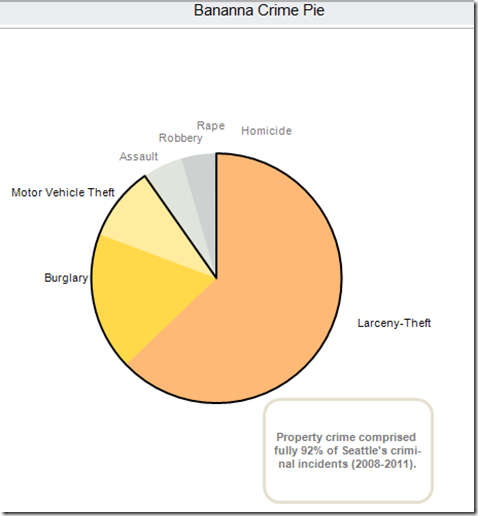
(Data set: Crime stats by precinct, 2008-2011)
This struck me as rather a lot of property crime for an area with such low levels of violent crime, so I tracked down a local Seattle beat cop to get some perspective on it. He told me about an interesting pawn shop sting the Seattle PD ran over the last year to attempt to address the rising property crime levels, named Operation Oliver’s Twist.
Mayor McGinn described Oliver’s Twist in a press conference on 3/6/2012:
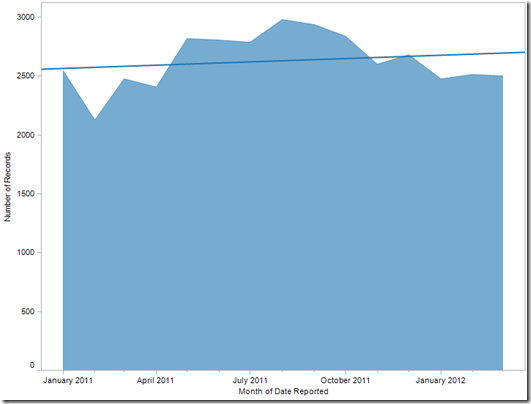
(Data set: Police report incident, used for the rest of this blog entry)
(Data transformations: here, you can see how I’ve defined Seattle property crime.)
Overall, property crime in Seattle hasn’t decreased since the sting arrests began in (assumed) Feb-March of 2012. In fact, from the regression line, you can see the total number of Seattle property crime incidents has actually increased a little.
Let’s break it down by district to see if we can see decreases in crime closest to the sting pawn shop. I used my data set to cobble together a basic Police District map of Seattle. The SPD pawn shop was located in Georgetown, which is in the light pink “O” district below.

Now we know that districts F, K, M, O, R and W are closest to the SPD pawn shop sting. We might (theory) expect to see property crime decrease most dramatically in those districts. To see the difference, I compared the number of property crime instances in the months of February and March in 2011, to the same period in 2012 (the estimated time of the arrests), in each district.
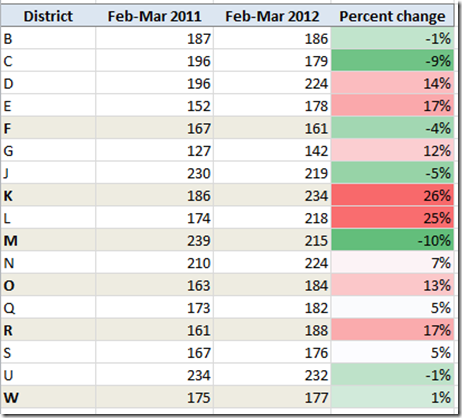
To make these stats a little clearer, let’s graph the change by district on our original district map. The blue circle describes the neighborhood of Georgetown, the location of the sting. Red indicates an increase in property crime incidents, green a decrease. From this map, we can see that the pawn shop location is surrounded by a lot of red – a lot of districts for whom property crime instances actually increased between 2011 and 2012.
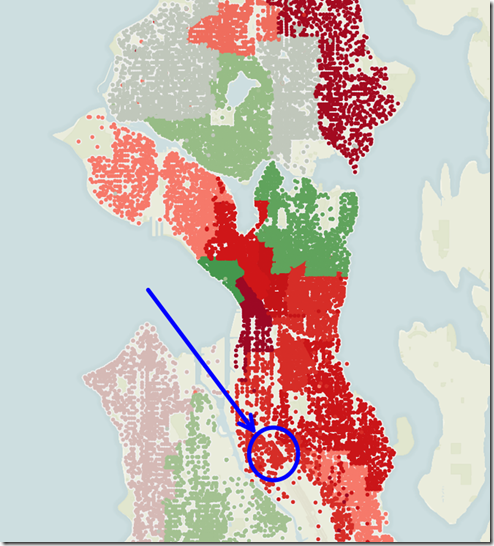
So, working from this data alone, it looks like the “Oliver’s Twist” sting in the O police district has not yet caused a decrease in property crime in neighboring districts.
It’s still possible that arrests are still ongoing, and the positive impact of the sting has yet to fully manifest itself. Looking at a rolling average since the beginning of February, we see that there has been a steady decrease in property crime in Seattle over the last few weeks (though levels still remain higher than this time last year). It’s interesting to note that the drop is substantially more pronounced in districts farther away from our Georgetown pawn shop.
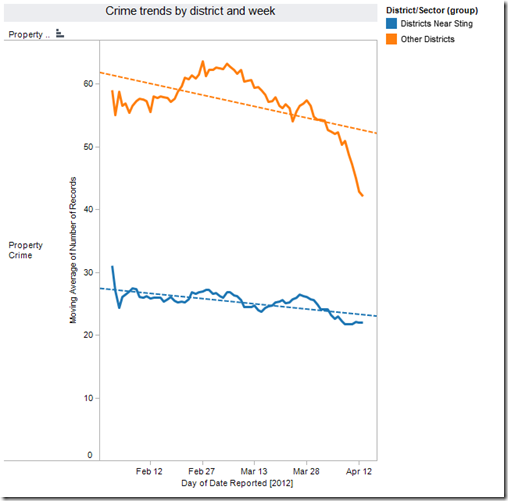
There are a lot of factors at play when it comes to measuring crime rates. How much might property crime rates have grown without this intervention? How have previous large-scale stings in Seattle and other areas impacted overall crime rates? Is it possible that there is a negative relationship between location and property predation? Perhaps criminals fence stolen goods intentionally far from where they grabbed them, and the “Other Districts” category is really the one that contains our signal. All interesting questions for the next intrepid analyst who wants to play in this space.
Here’s an example of how easy it can be to explore a data set when you combine powerful, user-friendly tools like Socrata (which publishes public sector data), and the free version of Tableau (a great visualization tool). To try this analysis out yourself, check out the Seattle Socrata data sets here, and the free public version of Tableau, here.
Property crime is Seattle’s biggest crime sector. When you combine vehicle theft, burglary, and larceny, you get 92% of Seattle’s criminal incidents.
“In 2010, Seattle bucked a national trend of declining property crime rates, with burglary and theft rates here increasing 3.2% in contrast to a 1.3% decrease across the country, according to data from the U.S. Department of Justice’s “Crime in the United States” report.” (article here)

(Data set: Crime stats by precinct, 2008-2011)
This struck me as rather a lot of property crime for an area with such low levels of violent crime, so I tracked down a local Seattle beat cop to get some perspective on it. He told me about an interesting pawn shop sting the Seattle PD ran over the last year to attempt to address the rising property crime levels, named Operation Oliver’s Twist.
Mayor McGinn described Oliver’s Twist in a press conference on 3/6/2012:
[D]etectives from the Seattle Police Department’s Major Crimes Task Force and the Pawn Shop/Property Recovery Unit, working with the King County Prosecuting Attorney’s Office (KCPAO) and the FBI, set up a storefront fencing operation – a tactic not used by SPD since 1979 – where undercover officers spent 11 months buying stolen goods from suspects for pennies on the dollar, with no questions asked.With initial results:
As a result of the operation, detectives identified 102 suspects involved in 314 separate criminal cases. Dozens of suspects were arrested and booked into jail over the last 24 hours on their outstanding cases.The question is: has this operation shown immediate results in reducing Seattle’s property crime?

(Data set: Police report incident, used for the rest of this blog entry)
(Data transformations: here, you can see how I’ve defined Seattle property crime.)
Overall, property crime in Seattle hasn’t decreased since the sting arrests began in (assumed) Feb-March of 2012. In fact, from the regression line, you can see the total number of Seattle property crime incidents has actually increased a little.
Let’s break it down by district to see if we can see decreases in crime closest to the sting pawn shop. I used my data set to cobble together a basic Police District map of Seattle. The SPD pawn shop was located in Georgetown, which is in the light pink “O” district below.

Now we know that districts F, K, M, O, R and W are closest to the SPD pawn shop sting. We might (theory) expect to see property crime decrease most dramatically in those districts. To see the difference, I compared the number of property crime instances in the months of February and March in 2011, to the same period in 2012 (the estimated time of the arrests), in each district.

To make these stats a little clearer, let’s graph the change by district on our original district map. The blue circle describes the neighborhood of Georgetown, the location of the sting. Red indicates an increase in property crime incidents, green a decrease. From this map, we can see that the pawn shop location is surrounded by a lot of red – a lot of districts for whom property crime instances actually increased between 2011 and 2012.

So, working from this data alone, it looks like the “Oliver’s Twist” sting in the O police district has not yet caused a decrease in property crime in neighboring districts.
It’s still possible that arrests are still ongoing, and the positive impact of the sting has yet to fully manifest itself. Looking at a rolling average since the beginning of February, we see that there has been a steady decrease in property crime in Seattle over the last few weeks (though levels still remain higher than this time last year). It’s interesting to note that the drop is substantially more pronounced in districts farther away from our Georgetown pawn shop.

There are a lot of factors at play when it comes to measuring crime rates. How much might property crime rates have grown without this intervention? How have previous large-scale stings in Seattle and other areas impacted overall crime rates? Is it possible that there is a negative relationship between location and property predation? Perhaps criminals fence stolen goods intentionally far from where they grabbed them, and the “Other Districts” category is really the one that contains our signal. All interesting questions for the next intrepid analyst who wants to play in this space.
Remember: all data sets are quirky, and no analyst infallible. Please have your own team confirm these results before basing any big changes on it.
Studying data science is a lot like being a data scientist
Note: Last year I decided to commit to data science as a career. I did this analysis to brush up on some skills, and to show potential employers how I solve problems. It worked like a charm, and I recommend it to new data science people. - K2 - 2013-04-01
Data science is like anything else: the best way to learn to do it is to do it. This is challenging if you’re winging it, because there isn’t a clear path laid out for newbies. There are lots of free / low cost resources out there, but most of them assume some previous knowledge from the other resources. It’s unclear what comes first, which data philosophy an author / instructor is operating on (there are several), or which techniques are most practical in the real world. Thus, learning data science is a lot like doing data science: you start with some half-formed questions, search and slice until you have some half-formed answers, organize them somehow, refine your questions and start again. Making it work curiosity, and a knack for sorting through giant piles of unsorted information and turning it into categories. The good news is: you’re probably already good at that, which is why you’re interested in data in the first place.
The other good news is that I’m going to lay out some of those steps & terms for you here. Personally, it drives me nuts when things are made to seem harder or more forbidding than they have to be. While data science isn’t for everybody, there are way more people out there who would be great at it, than there are people who know they would. The industry is going to need all of us: the ones who know they can do it and the ones who don’t. So, I figure, let’s lower the bar of entry. If each newbie works to make it easier on the next newbie, before we know it there’s an army of us well-poised to ask and answer fascinating new questions about human behavior.
The flip side is that since I’m just getting oriented myself. Collaboration is the steam that makes data science go: if you want to add a resource, step in the process, or advice to this ground-up tutorial series, let me know.
Next: we start by doing. I’ll set you up with a couple of user friendly tools that let you circumvent some (though not all) of the initial technical hurdles, so you can get directly into the fun part: data analysis.
Data science is like anything else: the best way to learn to do it is to do it. This is challenging if you’re winging it, because there isn’t a clear path laid out for newbies. There are lots of free / low cost resources out there, but most of them assume some previous knowledge from the other resources. It’s unclear what comes first, which data philosophy an author / instructor is operating on (there are several), or which techniques are most practical in the real world. Thus, learning data science is a lot like doing data science: you start with some half-formed questions, search and slice until you have some half-formed answers, organize them somehow, refine your questions and start again. Making it work curiosity, and a knack for sorting through giant piles of unsorted information and turning it into categories. The good news is: you’re probably already good at that, which is why you’re interested in data in the first place.
The other good news is that I’m going to lay out some of those steps & terms for you here. Personally, it drives me nuts when things are made to seem harder or more forbidding than they have to be. While data science isn’t for everybody, there are way more people out there who would be great at it, than there are people who know they would. The industry is going to need all of us: the ones who know they can do it and the ones who don’t. So, I figure, let’s lower the bar of entry. If each newbie works to make it easier on the next newbie, before we know it there’s an army of us well-poised to ask and answer fascinating new questions about human behavior.
The flip side is that since I’m just getting oriented myself. Collaboration is the steam that makes data science go: if you want to add a resource, step in the process, or advice to this ground-up tutorial series, let me know.
Next: we start by doing. I’ll set you up with a couple of user friendly tools that let you circumvent some (though not all) of the initial technical hurdles, so you can get directly into the fun part: data analysis.
Tuesday, March 27, 2012
No, you’re weird
Ever noticed how most behavioral research is based on studies of Western, upper-middle-class, undergraduate university students? If you, like me, are American, it might never occur to you to wonder whether those results can really be generalized to describe the behavior of "people." After reading The weirdest people in the world? (Western, Educated, 
This paper also has pretty much the best opening paragraph of any academic paper ever. Fair warning: it's not SFW.
Thursday, March 22, 2012
Where’s Gringo?
Because Americans are so geographically isolated, we are often less aware of the signature quirks of our own culture and perspective than are (say) people from patchwork continents like Africa, South America, Europe, The Artist Formerly Known as the Soviet  Union, etc. Our biases hide in plain sight. For a dose of cultural perspective from the comfort of your own beanbag chair, do not miss American Cultural Patterns. I’m told this tiny little book was written as culture-shock prep for undergraduates who were entering the Peace Corps, and were traveling overseas for the first time. It delves deeply into kernel-level cultural assumptions about communication, values, morality, the perception of time and causality - the list goes on. In my experience, reading any three pages of this book provokes an hour of fascinated discussion over the late-night-coffee of your choice.
Union, etc. Our biases hide in plain sight. For a dose of cultural perspective from the comfort of your own beanbag chair, do not miss American Cultural Patterns. I’m told this tiny little book was written as culture-shock prep for undergraduates who were entering the Peace Corps, and were traveling overseas for the first time. It delves deeply into kernel-level cultural assumptions about communication, values, morality, the perception of time and causality - the list goes on. In my experience, reading any three pages of this book provokes an hour of fascinated discussion over the late-night-coffee of your choice.Statistics in Plain English
Yesterday I picked up Statistics in Plain English, by Timothy C. Urdan, and I tell ya I can't put it down. From my review:
I think I can say, without fear of hyperbole, that this is the best math book in the history of the entire universe. The fact that there are only six reviews of the book so far, instead of six hundred, hints at the fundamental problem I personally see in math education: it looks harder than it is because we communicate so poorly about it. Urdan communicates clearly and naturally, so the chilly math textbook mystique drops away, and you are left with a functional vocabulary of basic stats techniques.
Urdan starts with the assumption that all humans can understand and benefit from statistical techniques. By assuming that, he makes it true. He not only defines every term and every symbol he uses -- which is already amazing -- but the new terms and definitions are summarized at the end of each chapter. He lays out lots of context and many straightforward and interesting examples. The chapters are short, which gives you a nice feeling of accomplishment and plenty of breaks to think. He even humanizes the experience by speaking in the first person, expressing personal preferences, and even cracking the occasional joke. It's like talking about math over tea with a good friend.

In the modern data space, there's a great shortage of people who have a comfortable intuition for stats. If this book were in every undergraduate class, I'd wager that shortage would just go away.
Monday, March 19, 2012
Perception of self-efficacy, and technology for developing countries
Kentaro Toyama, assistant director of Microsoft Research India, has spent a lot of time thinking about how to use technology to change social systems. He's focused on using technology to further development in rural India (ICT4D, or Information & Communications Technology for Developing Countries). He published a very cool set of essays in The Atlantic in 2011 about the topic. I've been thinking about them ever since. Check 'em out.
Kentaro talks about technology as basically an amplifier for people's will. Don't let the "virtue" language deter you; fully unpacked, it's a pretty loaded concept.
Sunday, March 18, 2012
Why you need an excellent data scientist
The data science hiring space in a nutshell:
Data geeks are a hot commodity. Why?
Data is piling up around the industry's ears. We humans are suddenly generating a mountainous drift of accumulating data, growing exponentially, that nobody anticipated having. That mountain is filled with profitable, scientific gems that we are just beginning to learn how to mine out.
The market is unprepared for the demand. Even with the rush to train data miners, the market isn't coming close to keeping up with the pace of the data mountain's growth. Folks like me are hounded by recruiters; folks with +5 years data mining experience/ education are actively stalked.
Data science salaries are growing. The supply/demand disparity is driving up salaries. According to one survey, in 2010, the average data miner salary in the US was $103k; in 2011, it was $113k.
So if professional data miners are so hard to get, why do you need one of us?
[Your Company Here] needs an excellent data scientist. If humans use your digital product, your company is already generating an enormous quantity of ultra-rich data. Based on that fact alone, I can make the following safe bets:
Your data is buggy. No matter how good your testing is, there will be bugs. The bigger the data, the badder the bugs. You are going to need a data analyst who can identify dirty data, scope the damage, and prescribe a solution. Skip that, and risk spending months acting on an interesting data trend that, in the end, describes nothing but a broken javascript call. I've seen it happen over and over.
Remember, the driver is as important as the car. If you want to make the best use of your BI application, your organization needs the right people to exploit it. BI is not just about reporting and visualization anymore. It involves intensive and creative analysis, along with data management, to create value for an organization. - Got BI? Now You Need to Hire a Data Geek. Here’s What to Look For.
Hal Varian, Google’s Chief Economist, was interviewed a few months ago, and said the following in the McKinsey Quarterly: “The sexy job in the next ten years will be statisticians… The ability to take data—to be able to understand it, to process it, to extract value from it, to visualize it, to communicate it—that’s going to be a hugely important skill.” - The Three Sexy Skills of Data Geeks
Data geeks are a hot commodity. Why?
Data is piling up around the industry's ears. We humans are suddenly generating a mountainous drift of accumulating data, growing exponentially, that nobody anticipated having. That mountain is filled with profitable, scientific gems that we are just beginning to learn how to mine out.
The market is unprepared for the demand. Even with the rush to train data miners, the market isn't coming close to keeping up with the pace of the data mountain's growth. Folks like me are hounded by recruiters; folks with +5 years data mining experience/ education are actively stalked.
CNN coverage: Companies that want to make sense of all their bits and bytes are hiring so-called data scientists - if they can find any. [...] A recent report from the McKinsey Global Institute says that by 2018 the U.S. could face a shortage of up to 190,000 workers with analytical skills.
So if professional data miners are so hard to get, why do you need one of us?
[Your Company Here] needs an excellent data scientist. If humans use your digital product, your company is already generating an enormous quantity of ultra-rich data. Based on that fact alone, I can make the following safe bets:
Your data is buggy. No matter how good your testing is, there will be bugs. The bigger the data, the badder the bugs. You are going to need a data analyst who can identify dirty data, scope the damage, and prescribe a solution. Skip that, and risk spending months acting on an interesting data trend that, in the end, describes nothing but a broken javascript call. I've seen it happen over and over.
Skill #2: Data Munging (Suffering). The second critical skill mentioned above is “data munging.” Among data geek circles, this refers to the painful process of cleaning, parsing, and proofing one’s data before it’s suitable for analysis. Real world data is messy. - The Three Sexy Skills of Data Geeks
Your data has a fluid architecture. As time moves on, your product evolves. Add a new option? Remove a feature? Need to view user behavior through a whole new lens? Like it or not, you have to change your data architecture while it is live. Every time that happens, you add more complexity. You need an analyst who can keep up with that.
Your data has, or should have, journeyman-level richness. If you send an apprentice-level data-miner into that trove, you're going to come out with a handful of iron ore. You can hire an apprentice analyst to run the queries you specify and graph them. You can't hire a apprentice to ask big, hot, actionable, counter-intuitive
With big data comes big headaches; also big, big opportunity for a reputation for genius product development. If your analyst can't handle the big hairy real-world data mess, or doesn't know statistical relevance from a hole in the wall, you get bunk analysis. If your analyst just plain isn't that into it, you will get shallow, token inquiry. If your analyst is a passionate data/social science geek, you get game-changing analysis, and stand to score media-worthy customer relationship coups.
Your data has, or should have, journeyman-level richness. If you send an apprentice-level data-miner into that trove, you're going to come out with a handful of iron ore. You can hire an apprentice analyst to run the queries you specify and graph them. You can't hire a apprentice to ask big, hot, actionable, counter-intuitive
With big data comes big headaches; also big, big opportunity for a reputation for genius product development. If your analyst can't handle the big hairy real-world data mess, or doesn't know statistical relevance from a hole in the wall, you get bunk analysis. If your analyst just plain isn't that into it, you will get shallow, token inquiry. If your analyst is a passionate data/social science geek, you get game-changing analysis, and stand to score media-worthy customer relationship coups.
Wednesday, May 21, 2008
Ruthbert
Note: If you are looking at this blog for serious professional reasons, and only want to see the non-silly entries, skip this one.
Welcome to the next episode of Ruthbert, wherein two non-colocated sardonic female information workers search for life, love, meaning, and original puns about bears.
K2: I spelled "for example" as "for exmaple"
this particular field goes out to all of you ex maples out there
don't ever go back, man
Ruth: snort
K2: Oh god, I'm sorry for this:
"I know you're pining away.... but don't fall off the wagon"
Ruth: NO
K2: "I'm not ON the wagon, man. I AM the wagon"
Ruth: NO K2 that's a BAD K2
K2: HA
HA HA
Ruth: now you go to your room and THINK about what you did
Ruth's statuses for April 08:
Ruth: travel doctor? is that like a miniature version of a doctor, that comes in a plastic carrying case?
K2: it's nice because he's magnetic on the bottom and doesn't tip over
Ruth: makes it harder to lose him under the seat, too
K2: sometimes you drop him and find him sticking perpendicular out of the gearshift
Ruth status: "whipped topping" is a phrase disturbing in its vagueness
K2 status: Officemate: What would you do without me? Me: I don’t know! Probably become a Pollyanna optimist with nothing but hope for the future and respect for Microsoft products. Officemate: I doubt that.
K2: crashed
Ruth: oh, that's no good
K2: I would like to drive a requirement into today's Ruth Release
it's a pry 2, but will support many other releases
it's called: More Talking
you'll note if you take a look at the process workflows that we would like at least 15 Funny Jokes included in this piece of functionality
Ruth: I don't know if 15 Funny Jokes is a realistic expectation of deliverables this late in the Release
what are your KPIs for the jokes?
K2: well
we're measuring them by funny sounds
like "ingers" and "oogle"
that's going to have the greatest customer satisfaction impact
"eezle"
also references to bears
Ruth: Those success metrics sound reasonable
here is my counter-proposal:
I should be able to get you 10 Funny Jokes by EOD
Ruth: we can push the remaining 5 out to tomorrow's release
K2: hmm
Ruth: and supplement in the meantime with Talking About Boys
K2: iiiinteresting
Ruth: my research has shown that customers respond almost as well to Talking About Boys
but admittedly, the sample size is small
K2: that may be bad news to our Future Humor Writers of America division, but the 13 Year Old Girl stakeholder group has been trying to push that change request through forever
I think we can ship this one
I crashed again
K2: my midday lonesomes are hitting
Ruth: you are not alone
you are at Microsoft
Steve Ballmer is probably spying on you right now
K2: it's going to be cloudy all weekend
but warm
Ruth: it better not hail
K2: I screwed up and scheduled a bunch of meetings for Memorial Day because nobody had blocked it off
including me
Ruth: oopsie
K2: this is how I covered my tracks: "On second thought, I'm going to declare Monday Memorial Day and give all of you guys the day off. No need to thank me. "
I have godlike powers
this is why it's valid and useful for you to bring your concerns about hail straight to me
Ruth: cows
I am wearing jeans yay!
K2: ME TOO
Ruth: yay
K2: that's why we're friends
Ruth: does that mean we're only friends on fridays?
K2: yes
UNLESS
you are ALSO usually wearing something that I also am usually wearing
like shoes
we could base our friendship on shoes
Ruth: or a bra
or an air of superiority
Welcome to the next episode of Ruthbert, wherein two non-colocated sardonic female information workers search for life, love, meaning, and original puns about bears.
K2: I spelled "for example" as "for exmaple"
this particular field goes out to all of you ex maples out there
don't ever go back, man
Ruth: snort
K2: Oh god, I'm sorry for this:
"I know you're pining away.... but don't fall off the wagon"
Ruth: NO
K2: "I'm not ON the wagon, man. I AM the wagon"
Ruth: NO K2 that's a BAD K2
K2: HA
HA HA
Ruth: now you go to your room and THINK about what you did
Ruth's statuses for April 08:
- One two three o'clock four o'clock BARACK
- Solid as Barack
- Barack-a-bye baby, in the treetop, when the wind blows the cradle will Barack
- We built this city on Barack and roll
- Hush little baby don't say a word, Obama's gonna buy you a Barackingbird
- Walk this way, Barack this way
- Barack me Amadeus
Ruth: travel doctor? is that like a miniature version of a doctor, that comes in a plastic carrying case?
K2: it's nice because he's magnetic on the bottom and doesn't tip over
Ruth: makes it harder to lose him under the seat, too
K2: sometimes you drop him and find him sticking perpendicular out of the gearshift
Ruth status: "whipped topping" is a phrase disturbing in its vagueness
K2 status: Officemate: What would you do without me? Me: I don’t know! Probably become a Pollyanna optimist with nothing but hope for the future and respect for Microsoft products. Officemate: I doubt that.
K2: crashed
Ruth: oh, that's no good
K2: I would like to drive a requirement into today's Ruth Release
it's a pry 2, but will support many other releases
it's called: More Talking
you'll note if you take a look at the process workflows that we would like at least 15 Funny Jokes included in this piece of functionality
Ruth: I don't know if 15 Funny Jokes is a realistic expectation of deliverables this late in the Release
what are your KPIs for the jokes?
K2: well
we're measuring them by funny sounds
like "ingers" and "oogle"
that's going to have the greatest customer satisfaction impact
"eezle"
also references to bears
Ruth: Those success metrics sound reasonable
here is my counter-proposal:
I should be able to get you 10 Funny Jokes by EOD
Ruth: we can push the remaining 5 out to tomorrow's release
K2: hmm
Ruth: and supplement in the meantime with Talking About Boys
K2: iiiinteresting
Ruth: my research has shown that customers respond almost as well to Talking About Boys
but admittedly, the sample size is small
K2: that may be bad news to our Future Humor Writers of America division, but the 13 Year Old Girl stakeholder group has been trying to push that change request through forever
I think we can ship this one
I crashed again
K2: my midday lonesomes are hitting
Ruth: you are not alone
you are at Microsoft
Steve Ballmer is probably spying on you right now
K2: it's going to be cloudy all weekend
but warm
Ruth: it better not hail
K2: I screwed up and scheduled a bunch of meetings for Memorial Day because nobody had blocked it off
including me
Ruth: oopsie
K2: this is how I covered my tracks: "On second thought, I'm going to declare Monday Memorial Day and give all of you guys the day off. No need to thank me. "
I have godlike powers
this is why it's valid and useful for you to bring your concerns about hail straight to me
Ruth: cows
I am wearing jeans yay!
K2: ME TOO
Ruth: yay
K2: that's why we're friends
Ruth: does that mean we're only friends on fridays?
K2: yes
UNLESS
you are ALSO usually wearing something that I also am usually wearing
like shoes
we could base our friendship on shoes
Ruth: or a bra
or an air of superiority
Monday, May 5, 2008
Gina Neff: Work and Power
Note: I have resolved to: (1) make my posts shorter so they stop eating my life, and (2) swerve, with a deft flick of the steering wheel, from my former outline of stuff that I was going to cover, to concentrating on my "Technology as Social Intervention: Discuss" topic, where I hope to learn more and rant less. It's all the same basic subject, though, so you may not even notice the difference.
That said, I went out a few weeks ago and interviewed Gina Neff, who is faculty at the UW Department of Communication. Gina is very taken with the concept of "work and power," and I wanted to ask her: what's the connection between the two? How do organizational structures dictate how power gets allocated to its members? And what happens to those power structures-- or to the communication dynamics of the org as a whole-- when you introduce new problem-solving technologies? If you are also geeky enough to find these topics interesting, you will find some of Gina's answers to those questions in the following few blog entries.
Information, Power and Tools
Gina has been studying these type of questions for years, and she has seen organizations' implicit power structures change radically with the addition of new technological tools, "magnifying existing power disparities," she says, "or breaking them down." The power-holders in an org may try to restrict how a tool is distributed or employed, or might even rally against it, if it seems like it has the potential to redistribute the power to make things happen. Alternatively (as in the following example), it might level the playing field, causing an initial chaos that leads to large changes to the org's workflows and the way its members define their own roles.
Gina is currently undertaking a study about the adoption of building information modeling tools in the construction industry. She explains:
Heterophily: Difference and Group Intelligence
It's not far-fetched to imagine that switching the wiring in an organization's communication structure could lead to huge changes. Cultures large and small, since the civilization of man, have kept themselves alive by employing one or another form of isolation: a mountain range, a separate language, secrecy, stereotyping, a forbidding initiation rite; Jews, for example, have kept Jewish culture alive, despite the diaspora, with the aid of lengthy and complex conversion processes, services conducted entirely in Hebrew, and dietary restrictions that can help limit who Jews eat with. If you move a culture's boundary devices, you change the way the culture lives. Build a highway, raise children bilingual, install a phone system, the internet: suddenly you find cultures blending, changing, and questioning the way they do things.
The contractors and architects in the system Gina is studying have historically been heterophilious. "Heterophily" is an amusingly polysyallabic term for "different in a way that makes communication between them hard." The words heterophily and homophily describe two ends of a spectrum: on the one side, you have two groups (or individuals) who are different to the point where they can't communicate at all (an American economist and a Bolivian witch woman); on the other side, you have groups who are so similar that communication between them is easy, but totally uninteresting (an American economist and an American economist ;) ). They have nothing to say to one another that they don't already know.
Want More of This Stuff? Check out:
... Gina recommends all of the above except, technically, the following blog entry. :)
Image pulled from here.
That said, I went out a few weeks ago and interviewed Gina Neff, who is faculty at the UW Department of Communication. Gina is very taken with the concept of "work and power," and I wanted to ask her: what's the connection between the two? How do organizational structures dictate how power gets allocated to its members? And what happens to those power structures-- or to the communication dynamics of the org as a whole-- when you introduce new problem-solving technologies? If you are also geeky enough to find these topics interesting, you will find some of Gina's answers to those questions in the following few blog entries.
Information, Power and Tools
Gina has been studying these type of questions for years, and she has seen organizations' implicit power structures change radically with the addition of new technological tools, "magnifying existing power disparities," she says, "or breaking them down." The power-holders in an org may try to restrict how a tool is distributed or employed, or might even rally against it, if it seems like it has the potential to redistribute the power to make things happen. Alternatively (as in the following example), it might level the playing field, causing an initial chaos that leads to large changes to the org's workflows and the way its members define their own roles.
Gina is currently undertaking a study about the adoption of building information modeling tools in the construction industry. She explains:
Historically, contractors (the folks who build the buildings) and architects have lived on opposite sides of the organizational divide. They spoke different languages and had different goal sets; they communicated via blueprints. This mutual organizational isolation allowed each group a lot of control over their spheres, but frequently made collaboration a painful, contentious mess. Each group guards its information and works at cross-purposes to the other, with miscommunications leading to mutual stereotyping, which itself helps reinforce the divide.
Gina is studying a transition that's taking place right now, before her eyes as she studies it: Today, builders and architects are beginning to share their visions via 3-D computer graphic tools and databases that represent the building being built. In other words, these groups are adopting a communications- and design- based technological innovation, and it is creating dramatic changes in the way they work together. The stereotypes are being put to the test as the groups are forced into proximity with one another, and each silo's private language is being opened up to the other. As Gina describes: "Their entire communications infrastructure has been channeled into different visual symbols, and is hardwired through different network pathways." Each group is also, in the process, losing some of the autonomy that came with that defended isolation.
Heterophily: Difference and Group Intelligence
It's not far-fetched to imagine that switching the wiring in an organization's communication structure could lead to huge changes. Cultures large and small, since the civilization of man, have kept themselves alive by employing one or another form of isolation: a mountain range, a separate language, secrecy, stereotyping, a forbidding initiation rite; Jews, for example, have kept Jewish culture alive, despite the diaspora, with the aid of lengthy and complex conversion processes, services conducted entirely in Hebrew, and dietary restrictions that can help limit who Jews eat with. If you move a culture's boundary devices, you change the way the culture lives. Build a highway, raise children bilingual, install a phone system, the internet: suddenly you find cultures blending, changing, and questioning the way they do things.

The contractors and architects in the system Gina is studying have historically been heterophilious. "Heterophily" is an amusingly polysyallabic term for "different in a way that makes communication between them hard." The words heterophily and homophily describe two ends of a spectrum: on the one side, you have two groups (or individuals) who are different to the point where they can't communicate at all (an American economist and a Bolivian witch woman); on the other side, you have groups who are so similar that communication between them is easy, but totally uninteresting (an American economist and an American economist ;) ). They have nothing to say to one another that they don't already know.
Want More of This Stuff? Check out:
- The next blog entry and maybe the one after it, where we talk about the consequences of these sorts of changes
- The stuff coming out of the The Center for Work, Technology and Organization at Stanford.
- Sorting things out: Classification and its Consequences (Bawker and Star)
- Talking about Machines (Julian Orr)
- Human Machine Configurations: Plans and Situated Actions (Suchman)
- Cognition in the Wild (Hutchins)
... Gina recommends all of the above except, technically, the following blog entry. :)
Image pulled from here.
Tuesday, April 1, 2008
1.2 No I in Meme: Culture (White People are White)
Though it is a step further away from my basic focus on social systems and technology, I would be remiss in my duties as a lister-of-social-structures if I did not list the most pervasive and unconscious structure of all: culture.
I write this entry with a mild, throbbing pain in my left Heresy Lobe, an old sports injury incurred from climbing too many times up onto my old soapbox about individualism in American culture. I threw a tarp over it when I graduated from grad school, but I am formally breaking out my carnie barker voice and bowtie as we speak.
What, you ask, is my hangup about individualism and American culture? (Watch my friends dive into bushes and roll off screen as I respond.) Recall that my basic point here is that structure determines behavior: it affects our actions, belief systems, perception of ourselves, and our conception of our options in the world. If you know about the structure, you have a little more free will; if you don't, you run a high risk of unthinkingly incorporating its mandates.
We Americans are particularly susceptible to this, and particularly blind to that susceptibility. Perhaps you have heard the joke:
We Americans have, by and large, "drunk the Kool-Aid" of American culture, and so we take the nourishment and the carcinogens together and call them "humanity." We are highly susceptible to the negative societal and psychological side-effects of our quirks. Where we are individualistic by culture, we fall prey to loneliness or rudeness; where we are materialistic, we fall prey to the existential vacuum. Etc etc.
The question of "what is human nature" vs "what is American culture" has always fascinated me, and so I learned some foreign languages, spent a non-small portion of my life living in third-world countries, and focused my undergraduate thesis on social-cultural constructs and how they affect self-perception and relationships.** I only suggest you also do this if you, too, want to contract the Tourette's Syndrome-esque tendency to rant uncontrollably. If you would instead prefer a more moderate and salmonella-free immersion in the topic of the great spectrum of cultural structures, I strongly recommend the book American Cultural Patterns. It was written some 20 years ago to prepare first-time Peace Corps workers for culture shock. It is short and highly readable and will completely mess up your mind. It is one of the best nonfiction books I have ever read; I can't go five pages without bolting up from my chair to discuss it with someone.
Allowing yourself to question your own deep, foundational assumptions about human beings, relationships, success, time, reason and language can be a seriously unsettling experience. It can lead to cognitive dissonance, the discomfort that arises from a stark contradiction between what one believes to be so and what appears to be true; human beings are typically so extremely averse to that discomfort that they will usually become angry, or contstruct elaborate and transparent untruths, to avoid feeling it (a fascinating cognitive bias which I'll talk about sometime later).
This cognitive dissonance is sometimes fun for insensitve counterculturalists like to me to play with...
Next: >> I thought I could rant about this in one entry, but I was oh so very wrong. >>
**My web page is really really outdated. It's going to stay like that for a while.
I write this entry with a mild, throbbing pain in my left Heresy Lobe, an old sports injury incurred from climbing too many times up onto my old soapbox about individualism in American culture. I threw a tarp over it when I graduated from grad school, but I am formally breaking out my carnie barker voice and bowtie as we speak.
What, you ask, is my hangup about individualism and American culture? (Watch my friends dive into bushes and roll off screen as I respond.) Recall that my basic point here is that structure determines behavior: it affects our actions, belief systems, perception of ourselves, and our conception of our options in the world. If you know about the structure, you have a little more free will; if you don't, you run a high risk of unthinkingly incorporating its mandates.
We Americans are particularly susceptible to this, and particularly blind to that susceptibility. Perhaps you have heard the joke:
Q: What do you call someone who speaks three languages?The USA hosts one of the most geographically and linguistically isolated urban cultures in the world. That makes us Americans very different than (for example) European, Latin American or Asian cultures when it comes down to knowing that we have a culture at all. Even when we do travel, we rarely stay long or become fluent in the local language, and thus we miss volumes about what culture really is: arbitrary, powerful, silly or objectionable. We are convinced that everything we do as Americans is "just human nature" or "the same all over the world."
A: Trilingual.
Q: What do you call someone who speaks two languages?
A: Bilingual.
Q: What do you call someone who speaks one language?
A: American!
Living overseas for a year is a great way to recognize that what you are, and how you do things, is not "the default way." Most of us, though, can discover this bias in ourselves from our desk chairs. Give it a shot: if you are Black, say out loud "I am Black." If you're Chinese, Japanese or Korean, say so. If you are White, say "I am White."
So, the first two may come easily. But most White people will become very uncomfortable openly stating we are White. To us, we are not White: we are normal. We do not behave like White people; we behave normally, while Black people behave like black people and Japanese people behave like Asians.
I, the writer of this blog, am a White American person, and mostly I behave just like one. I am a consumer, I'm highly innovative, very individualistic, stuffy about sex, outgoing; I wait patiently in lines; I have a large "personal space" envelope, and get antsy when all but specific people touch me at all but agreed-upon times; I am more standoffish and disingenuous than the most uptight Latin American, and my friendships are usually shallower and more transient than the most cynical European (though I am working hard to shake those two).
Are you a White American? In what ways do you behave just like a White American, and in what ways do you behave differently? Does this whole section make you wince and hold your breath? If so, why?
We Americans have, by and large, "drunk the Kool-Aid" of American culture, and so we take the nourishment and the carcinogens together and call them "humanity." We are highly susceptible to the negative societal and psychological side-effects of our quirks. Where we are individualistic by culture, we fall prey to loneliness or rudeness; where we are materialistic, we fall prey to the existential vacuum. Etc etc.
The question of "what is human nature" vs "what is American culture" has always fascinated me, and so I learned some foreign languages, spent a non-small portion of my life living in third-world countries, and focused my undergraduate thesis on social-cultural constructs and how they affect self-perception and relationships.** I only suggest you also do this if you, too, want to contract the Tourette's Syndrome-esque tendency to rant uncontrollably. If you would instead prefer a more moderate and salmonella-free immersion in the topic of the great spectrum of cultural structures, I strongly recommend the book American Cultural Patterns. It was written some 20 years ago to prepare first-time Peace Corps workers for culture shock. It is short and highly readable and will completely mess up your mind. It is one of the best nonfiction books I have ever read; I can't go five pages without bolting up from my chair to discuss it with someone.
Allowing yourself to question your own deep, foundational assumptions about human beings, relationships, success, time, reason and language can be a seriously unsettling experience. It can lead to cognitive dissonance, the discomfort that arises from a stark contradiction between what one believes to be so and what appears to be true; human beings are typically so extremely averse to that discomfort that they will usually become angry, or contstruct elaborate and transparent untruths, to avoid feeling it (a fascinating cognitive bias which I'll talk about sometime later).
This cognitive dissonance is sometimes fun for insensitve counterculturalists like to me to play with...
Next: >> I thought I could rant about this in one entry, but I was oh so very wrong. >>
**My web page is really really outdated. It's going to stay like that for a while.
Tuesday, March 25, 2008
Ruthbert
My hilarious friend Ruth and I have been keeping each other company from our disparate, cross-city desk-jockey gigs for going on three years now. She works in search optimization.
Here, for posterity, are some of my recent conversations with her:
Ruth: I just accidentally sent an email asking someone for an "estimeat"
Ruth: :'(\
mr. stabby-face feels your pain
Ruth: he is sad because he has been stabbed in the face
K2: oh I hate getting lunch
I always feel guilty that I did not prepare my own
K2: I currently do all my cooking at D's on the weekends
weeknights I live on prayer and the non-kosher noodle bowls I keep in my bedroom
Ruth: you should prepare your own lunch then!
[Ruth delivers office lunch recipe]
K2: I have noted your recipe and will take it up with my manager for possible inclusion in a future release
however this week's release is full, I'm sorry
Ruth: mission statement: to increase lunch-eater value by improving lunch efficiency and reducing lunch spend, while maintaining current levels of lunch deliciousness
K2: of course you realize you're going to have to get signoff from the downstairs cafeteria lady, she's a stakeholder in this
and they're veeeery preoccupied with their chicken parmesean release right now, so good luck getting on THEIR radar
Ruth: I'm confident that the impact to downstairs cafeteria lady will be within acceptable bounds to her organization, and will be more than offset by the increased value offered by the new K2 lunch plan
K2: Have you consulted EMEA? I'm sure that the Latin regions will buy in to the tortillas, but I don't know if you're aware of this, EMEA's servers are all allergic to gluten
Ruth: it wouldnt' be stored on EMEA's servers, it would be stored directly on K2's work fridge servers
and tortillas can be desk-hosted for several days before losing optimum freshness
Ruth: I am gradually accumulating Buffy seasons, when sale prices coincide with coupon-having on my part. M calls the shelf where I store them the "Garden of Whedon."
K2: 7 more bottles of meetings on the wall, 7 more bottles of meetings
cancel one down, send it around, 6 more bottles of meetings on the wall
Ruth: I hope that someone gets my
meeting in a bottle yeah
K2: I wrote a song on the way in to the tune of that "Shorty got low" song.
Here it is:
She had the powerpoint deck
And the laser poin-ter
The whole conference call was lookin' at her
Ruth: She hit her visio
next thing you know
spending got low, low, low, low low low
she had the Excel spreadsheet
and that ThinkPad in her lap
she turned around and gave that big budget a slap
Hey! She hit her visio
next thing you know
spending got low low low low low low
Ruth: in the last 6 weeks there have been 133 searches for the phrase "nose bidet"
Thursday, March 13, 2008
1.2 There is no "I" in "Meme": Language
The language we use, whether it beongs to our culture, subculture, technical tool or organization, affects our fundamental perceptions, choices, and behavior (and we rarely notice).
[T]he language a person speaks [affects] how that person both understands the world and behaves in it. [...] Different language patterns yield different patterns of thought. -- Sapir-Whorf Hypothesis, WikipediaThe world, and the process of living, are inherently continuous and nameless. To communicate about them, we humans use our amazing minds to interpret them down into structures, finite bits with ends, beginnings and apparent affinities with other bits. We come up with those structures by drawing from our history, our cultural biases, our priorities, which themselves are created by language in an ongoing feedback loop. There is no "accurate" way of describing the world, and thus there is no objective way. There's just the way that you happen to be using.
A language is a very heavily biased cultural description of the parts of the world that it cares about, and its own priorities. For example:
In American culture (and some, but not all, other cultures), words about sex and sexual organs are used as the strongest forms of insults. It would be ridiculous for me to insult you by calling you a "stupid arm," but we find the word [cxxx] so offensive that I can't even directly reference it in this blog. This use of language reflects, and perpetuates, certain cultural assumptions about sex.
The languages of subcultures and organizations also codify, teach and perpetuate, unconscious cultural values and expectations.
A close friend of mine just became a cop. He is a deep and thoughtful person with a strong protective instinct. I was thus surprised, in recent conversations, to hear him talking about apprehending and charging people as "contacting" his "clients."
For me, "contacting a client" means calling someone who has voluntarily hired you and maybe leaving them, say, a voicemail, or perhaps a nice fruit basket. For his unit, "contacting" someone might mean chasing a guy four blocks, fighting him to the ground with the help of three other officers, finding a gun and a gram of coke on him, and taking him to jail where he will develop his first criminal record, permanently changing the course of his life.
Contrast this linguistic convention to some other options: instead of "Today I contacted four clients," make it "Today I handled, then made life-changing decisions towards, four human beings." Or, alternately: "Today, I wiped the floor with four more scumbags." The neutral language employed by my friend's unit serves two instructive purposes: it facilitates the emotional detachment that makes policework possible, and it restricts that detachment to the universe of professionalism and service.
So, yes: the linguistic structure you use effects how you think and act. But while changing a language is often a part of changing a social system's rules and behavior, it is rarely the direct route. If you had a goal, for example, to make all police highly sensitive to the human realities of the people they are arresting,* you might think it would be smart to change the institutional language from "contacting clients" to "Making Choices to affect Human Beings." But if your police still (for example) (1) have to fill an ambitious weekly quota of arrests to succeed at your unit, and (2) only see the perp at the time of the arrest (no exposure to context or after effects), your new language won't change their approach to the job. It will just irritate them as phony polish on top of the job's harsh reality.
I don't know about you, but I see surface-level language "fixes" in the industry all the time, and they drive me directly to drink.
To learn more about this fascinatng topic, you may want to read this highly-recommended book: Sorting Things Out: Classification and its Consequences.**
* And I hope you do not
** Lord knows I want to read it. It's on my short list.
Stay tuned for: 1.3 There is No "I" in "Meme": Culture
Contrast this linguistic convention to some other options: instead of "Today I contacted four clients," make it "Today I handled, then made life-changing decisions towards, four human beings." Or, alternately: "Today, I wiped the floor with four more scumbags." The neutral language employed by my friend's unit serves two instructive purposes: it facilitates the emotional detachment that makes policework possible, and it restricts that detachment to the universe of professionalism and service.
So, yes: the linguistic structure you use effects how you think and act. But while changing a language is often a part of changing a social system's rules and behavior, it is rarely the direct route. If you had a goal, for example, to make all police highly sensitive to the human realities of the people they are arresting,* you might think it would be smart to change the institutional language from "contacting clients" to "Making Choices to affect Human Beings." But if your police still (for example) (1) have to fill an ambitious weekly quota of arrests to succeed at your unit, and (2) only see the perp at the time of the arrest (no exposure to context or after effects), your new language won't change their approach to the job. It will just irritate them as phony polish on top of the job's harsh reality.
I don't know about you, but I see surface-level language "fixes" in the industry all the time, and they drive me directly to drink.
To learn more about this fascinatng topic, you may want to read this highly-recommended book: Sorting Things Out: Classification and its Consequences.**
* And I hope you do not
** Lord knows I want to read it. It's on my short list.
Stay tuned for: 1.3 There is No "I" in "Meme": Culture
Tuesday, March 4, 2008
1.1 How to Build Horrible Social Systems by Accident: Incentives
In the last entry, I proposed that tools and organizations, often (make that usually-- actually make that almost always) unintentionally bake into their very structures a set of implicit instructions for their members / users about what behavior is appropriate, rewarded, or discouraged.
How, exactly, do they do that? Here are some of many possible answers.Incentive Systems. Behaviors rewarded by your system or tool will grow in emphasis and frequency; behaviors that are punished will become less frequent. This statement may seem obvious; people are always trying to leverage positive or negative incentives to get one another to do things. Unfortunately, those conscious incentive programs are usually laid on top of preexisting incentive systems that are deeper, more subtle, more ubiquitous, and far less intentional. In other words, they are much more convincing to the people involved, and are impossible to casually override.
Example: You have a new software company, and you have to hire some people and then give them employee reviews of some kind. Like many orgs, you base your employee review system on whether or not an employee succeeds at his projects. If he succeeds at all of them, he gets a raise; if he fails at his projects, he gets a poor review and a lower bonus. If he gets three poor reviews in a row, he gets fired.While this seems like a simple and obvious incentive system, you are literally incenting your average employee (let's call her Martha Generic) to succeed at her own projects… even if that messes up everyone else's. If she sacrifices her own project, one quarter, to enable four other projects to succeed, she will still be punished by your system.
Example, Cont'd: Five years down the line (after every manager in your company has worked your incentive system into dozens of mini-processes and deliverables), you discover your employees aren't collaborating. You say to yourself: "These poor geeks just don't know how to collaborate. I've got to get them thinking like a team…"
You start publishing some weekly articles on the importance of collaboration. You deliver a motivational speech to the whole company about how software development is really about putting "people first." You offer a trophy for the "most collaborative team member."
Will it work?
What would happen if you created an online community (let's say, a "resource group for workaholics") and let your members give each other public ratings (1-5 stars) on two things: "Humor" and "Best Vocabulary"? … What if it were an automated system that gave privileges based on "Most Links Contributed"?
Next up: 1.2 There is no I in Meme: Language and Messaging
1.1 How to Build Horrible Social Systems by Accident: Incentives
In the last entry, I proposed that tools and organizations, often (make that usually-- actually make that almost always) unintentionally bake into their very structures a set of implicit instructions for their members / users about what behavior is appropriate, rewarded, or discouraged.
How, exactly, do they do that? Here are some of many possible answers.
Incentive Systems. Behaviors rewarded by your system or tool will grow in emphasis and frequency; behaviors that are punished will become less frequent. This statement may seem obvious; people are always trying to leverage positive or negative incentives to get one another to do things. Unfortunately, those conscious incentive programs are usually laid on top of preexisting incentive systems that are deeper, more subtle, more ubiquitous, and far less intentional. In other words, they are much more convincing to the people involved, and are impossible to casually override.
Example: You have a new software company, and you have to hire some people and then give them employee reviews of some kind. Like many orgs, you base your employee review system on whether or not an employee succeeds at his projects. If he succeeds at all of them, he gets a raise; if he fails at his projects, he gets a poor review and a lower bonus. If he gets three poor reviews in a row, he gets fired.While this seems like a simple and obvious incentive system, you are literally incenting your average employee (let's call her Martha Generic) to succeed at her own projects… even if that messes up everyone else's. If she sacrifices her own project, one quarter, to enable four other projects to succeed, she will still be punished by your system.
Example, Cont'd: Five years down the line (after every manager in your company has worked your incentive system into dozens of mini-processes and deliverables), you discover your employees aren't collaborating. You say to yourself: "These poor geeks just don't know how to collaborate. I've got to get them thinking like a team…"
You start publishing some weekly articles on the importance of collaboration. You deliver a motivational speech to the whole company about how software development is really about putting "people first." You offer a trophy for the "most collaborative team member."
Will it work?
What would happen if you created an online community (let's say, a "resource group for workaholics") and let your members give each other public ratings (1-5 stars) on two things: "Humor" and "Best Vocabulary"? … What if it were an automated system that gave privileges based on "Most Links Contributed"?
Next up: 1.2 There is no I in Meme: Language and Messaging
Monday, February 25, 2008
1 of 4: Structure Influences People
Premise #1.0: The structure of a tool influences the people who use it, and the structure of an organization influences the people who belong to it.
Premise #1.1: We don't act nearly as independently as we think we do. All day long, we are listening for cues about what behavior is appropriate in each context. We also broadcast cues as to what behavior is rewarded, acceptable, or inappropriate.
This is our symbolic, implicit, fantastically complex language of human aggregation: we tell each other what to do all day long without saying a word.
Next up: 1.5: How to Build Horrible Social Systems by Accident: Incentives. This is one of several entries fleshing out the theme of "Structure Influences People." It will be the first in, time willing, a short list of tools I learned about in academia that aim to analyze structure and its influences.
Premise #1.1: We don't act nearly as independently as we think we do. All day long, we are listening for cues about what behavior is appropriate in each context. We also broadcast cues as to what behavior is rewarded, acceptable, or inappropriate.
Example A: You're invited to an acquaintance's house; he's "having some cool people over." He has spiky hair and a nose ring. So, you grab your Immortal Technique CDs and take a cab out to his place, expecting to tie one on and get loose. You get there and discover that, (1) the table is set with a white tablecloth and matching silverware, and (2) there are wine glasses. You instantly realize this is a Grownup Party. Chagrined, you start greeting the other guests with conversation about work while privately lamenting your wasted $30 on cabfare.
Example B: Usually, the lady checker with the orange hair at the Red Apple asks "How are you?" in a monotone while she's typing your produce codes with one hand and checking her watch with the other. You respond: "Fine, thanks, and you?" But today, she notices you look kinda off. You come up to the counter, and she sets her pen down and places both hands on the counter. She looks into your eyes, and says: "How are you?" You say: "Pretty lousy. I'm just not sleeping well. I stress too much."
This is our symbolic, implicit, fantastically complex language of human aggregation: we tell each other what to do all day long without saying a word.
Organizations and tools bake these messages into formal structures that tell people what behavior is desirable and what is unacceptable. When we successfully and ritually use the tool or belong to the organization, we adopt those behaviors. Usually, we adopt them unknowingly; often, we do it involuntarily.
Premise #1.2: It's important to set up tools and systems to encourage the behaviors that you want, and discourage the behaviors that you don't.
The more unconscious those behavioral handshakes between us and our org/tool, the more likely they are to affect our perception of ourselves, and our ability to see a broad set of options and to make decisions.
Premise #1.3: If you have a system where a group of people are doing the same odious thing over and over again no matter how often you try to get them to stop, look at the rules of the system they belong to.
Subscribe to:
Posts (Atom)